Demo Lab
We like to think of Summit as the nerd table in high school, all grown up. And what person who sat at that table (we know you were there with us) didn’t love a science fair?
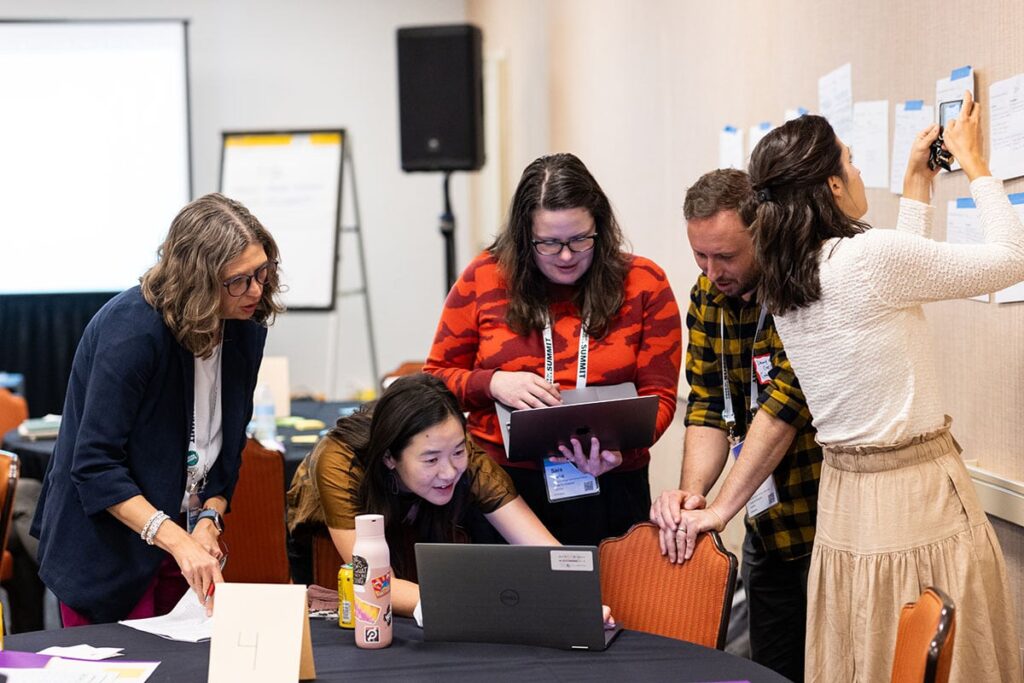
The Demo Lab is an interactive showcase at Code for America Summit, designed to bring together tech innovators, government problem-solvers, and creative thinkers.
This is your chance to explore and share solutions that address real-world challenges, gain valuable feedback, and be part of a one-of-a-kind Summit experience.
Visit the Demo Lab on Day 2 of Summit
Friday, May 8 | 2:30–4:30 p.m.
Generative AI-Powered Translation for Benefits Access: Arizona’s Low-Code Solution
USDR partnered with the Arizona Department of Economic Security to build a low-code generative AI translation workflow that transforms SNAP communications from complex jargon into accessible plain language in English and Spanish. Using Google Workspace and curated context materials, including user-tested glossaries, configurable prompts, and evaluation tools, DES team members will be able to translate content in a matter of minutes while significantly reducing vendor costs. The existing solution requires no specialized IT infrastructure, making it available to internal teams, programs, and divisions regardless of technical maturity. This demo showcases the complete workflow: from initial request to AI-generated translation to human review. Attendees will see how USDR’s human-centered approach addresses both resident needs and government capacity constraints, making benefits accessible to Arizona’s 850,000 SNAP participants. The modular design enables rapid adaptation across benefits programs, jurisdictions, and languages, demonstrating a scalable path forward for equitable service delivery nationwide.
- Marcie A. Chin, Product Delivery Manager, U.S. Digital Response
- Michael Boyce, Generative AI Lead, U.S. Digital Response
Eight Weeks to Production: Pennsylvania’s Benefits Status Tracker and AI Document Screening
As part of a larger engagement to reduce SNAP payment error rates, Pennsylvania launched five simultaneous projects to improve benefits access. They’ll demo two parallel efforts: TrackMyBenefits.pa.gov, built and deployed in eight weeks to let residents check their benefit status without needing to log in, and a pilot using Intelligent Document Processing (IDP) to pre‑screen income documents before human review. Both projects offer cross-functional teams lessons in rapid response, resilience, and resident‑centered innovation.
- Karissa Demi, Head of Backend Engineering, CODE PA
- Laurence Goolsby, Software Engineer, Nava
A Faster Way to Surface, Understand, and Repair Broken Civic Processes
Civic Lens is a civic-intelligence platform that helps governments and funders see where public-facing systems are failing people. It lets teams upload real resident evidence (interviews, transcripts, screenshots, observations), automatically extracts friction points using machine learning and LLMs, and visualizes system breakdowns through journey maps, root-cause clustering, and cross-city pattern detection. Instead of waiting for a six-month consulting report, Civic Lens gives leaders a fast, visual diagnostic layer that shows where users drop off, where staff hit walls, and where dollars aren’t turning into outcomes so they can fix what matters first.
- Alex Johnston, CEO, Cities Reimagined
Building Open-Source Medicaid Compliance Together
When Congress introduced new work requirement reporting rules, many states were told they’d need expensive, proprietary modules to comply. Instead, a small group of advocates, and open-source contributors took a different path. Together, they built Open-Source Community Engagement Reporting (OSCER) app, an open-source approach that lets any state implement a transparent, reusable “sidecar” for determinations without waiting on black-box systems or vendor timelines. This session walks through the journey: how community members translated federal policy into data structures real people could implement, how community members shaped a minimal, interoperable integration contract, and how open governance made every decision accountable and public. People who check out this demo will leave with a clear understanding of the determination schema, batch/API patterns, and the steps to stand up the sidecar in a state cloud environment.
- Ed Mullen, Technical Solutions Director, Nava PBC
- Sumi Thaiveettil, Senior Product Manager, Nava PBC
Democratizing Data: How Maryland’s Digital Compass Bridges Essential Service Gaps
Small businesses are critical infrastructure and provide essential services within Maryland communities; however, high-poverty neighborhoods have 36% fewer child care centers and 30% fewer grocery stores than affluent neighborhoods. The Maryland Community Business Compass is a free platform helping entrepreneurs close these gaps by bringing local market opportunities, public incentives, and trusted support into one place. Co-designed with residents and essential service providers, the platform uses AI to surface needs from 18,000 pages of community plans and centralizes over 70 public funding sources. The Compass is a working example of government using data and AI to drive real, place-based outcomes.
- Charlie Rixey, Deputy Director, Maryland State Innovation Team in the Office of Governor Wes Moore
- Alex Miller, Data Scientist, Maryland State Innovation Team in the Office of Governor Wes Moore
Improving LLM Access to Federal Data: An MCP Pilot Study
Federal data has long served as a cornerstone for critical societal functions: guiding public benefit programs, supporting scientific research, shaping economic policy, and informing agricultural planning. While traditionally this information was accessed directly through reports, databases, or agency websites, the increasing use of AI systems by individuals and organizations to find and interpret data creates an imperative to make federal data AI-accessible. This team evaluated the Model Context Protocol (MCP), an emerging open-source standard designed to enable structured, context-aware API interactions with AI systems, as a solution for improving AI access to federal data. Using MCP servers, the team developed for two federal datasets and found that AI system accuracy in retrieval and interpretation of federal data jumped from 18% to 95%. Their findings demonstrate a viable strategy to dramatically expand access, transparency, and meaningful engagement with government data.
- Haley Johnson, Data Scientist, U.S. Digital Corps
- Bella Mendoza, Data Scientist, U.S. Digital Corps
The People Say: A Qualitative Research Platform for Informed Policymaking
The Public Policy Lab, in partnership with the SCAN Foundation, created The People Say: a searchable qualitative research platform that elevates the voices of older adults, especially those from low-income, rural, and underrepresented communities. Built from 200+ hours of ethnographic interviews across 15 states, the platform contains thousands of tagged video clips, quotes, and insights that make lived experience data easy to explore and apply. This demo will show participants how to search by keyword, filter by topic or demographics, and browse insight pages to understand how policies shape daily life. Presenters will also share the research and design decisions behind the platform, such as the custom taxonomy and interface, that make qualitative data searchable and actionable. Attendees will leave with a clear understanding of how the platform works and a framework for adapting this approach to other populations, challenges, or policy questions.
- Petey Routzahn, Advisor, Public Policy Lab
- Jessica François, Consultant, Public Policy Lab
Electrify Chicago: Bringing Building Emissions To Light
Electrify Chicago is an open-source website that leverages existing open-data to create pages that show the emissions and energy use of large Chicago buildings. The project showcases both how open data can be leveraged by private citizens to create change, and the power of visualization and data analytics in understanding big problems. The underlying data has existed for over a decade, but hasn’t seen any news coverage or serious attention, and Electrify Chicago hopes to make this information more visible as well as more understandable, so Chicagoans can see vital information on their buildings that was already public, like energy use and emissions, helping push for building-level and legislative change.
- Viktor Koves, Lead Developer, Electrify Chicago
- Hunter Yeago, Developer, Chi Hack Night
Extracting and Validating Insights from Case Note Data
Like many government agencies, Departments of Corrections (DOCs) generate millions of unstructured free text case notes every year. These presenters demonstrate how they use LLMs to extract and validate crucial, previously hidden insights from this data, supporting better continuity of care and measuring previously unmeasureable outcomes like time to stable housing and employment. The demo will showcase specific LLM prompts used for extraction. They’ll run a live call, demonstrating how unstructured text is converted into structured data points that can be built into product surfaces and analyses to support individuals and measure alternative system outcomes.
- Sophie Pepin, Manager, Data Analytics, Recidiviz
- Ben Packer, Staff Data Scientist, Recidiviz
Schedule subject to change without notice.